Boron Removal From Water: Methods, Design Factors and Resin Selection
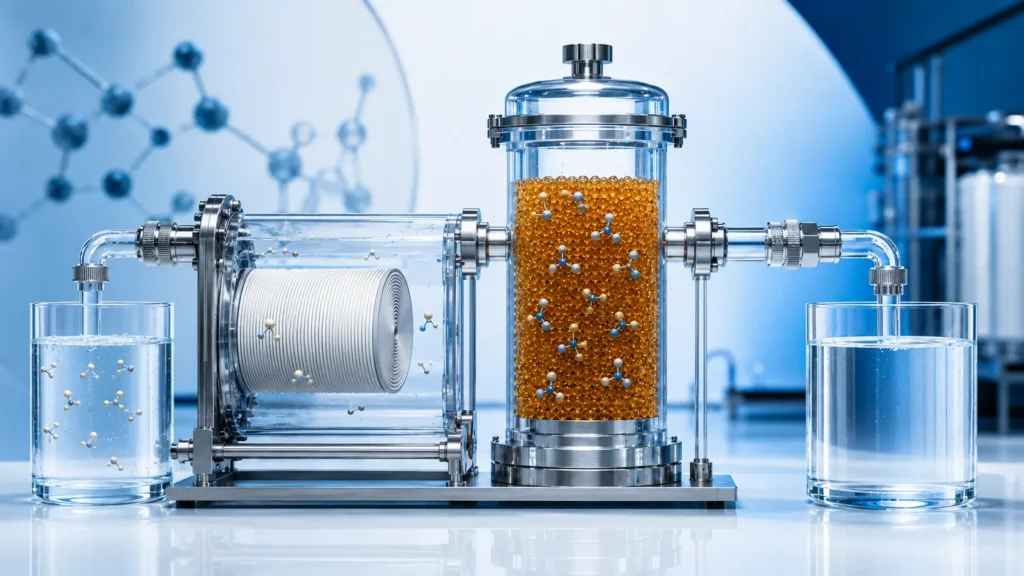
Boron removal from water is trickier than most people expect. Regular filters, activated carbon, and standard softeners don’t cut it because boron mostly exists as tiny, neutral boric acid molecules that slip right through. The real fix is reverse osmosis, boron selective resin, or both together, depending on your water’s boron level, pH, temperature, salinity, target outlet reading, flow rate, and end use.
For seawater or high TDS sources, RO usually handles the bulk removal first, often followed by a second pass or resin polishing to finish the job. If you’re starting with lower boron but need a strict final limit, selective resin alone can often get you there.
Key Takeaways
- Boron stays neutral (as boric acid) below roughly pH 9.2, making it hard to trap.
- Carbon filters, sediment filters, and softeners aren’t built for dissolved boron.
- Higher pH converts boric acid into borate, boosting RO rejection.
- Selective resin removes boron without needing that pH shift.
- RO plus resin is usually most reliable for strict limits.
- Treatment should follow a full water analysis, not boron alone.
- Any performance claims need pilot testing and lab data to back them up.
What Is Boron in Water?
Boron is a natural element you’ll find in rocks, soil, seawater, and mineral deposits. It almost never turns up in water in its pure elemental form. Instead, it dissolves into water mainly as boric acid, along with a few different borate compounds.
Common sources include:
- Weathering of boron containing rocks and soil
- Seawater intrusion into groundwater
- Geothermal water
- Municipal wastewater discharge
- Mining and mineral processing effluent
- Glass, ceramic and detergent manufacturing
- Fertilizer and agricultural runoff
- Oil and gas produced water
- Reverse osmosis concentrate and industrial brine
Boron levels vary widely by source, surface water, groundwater, seawater, and industrial wastewater all differ. Seawater generally has more boron than freshwater, while some geothermal and industrial streams can run even higher.
Why Is Boron Removal From Water So Difficult?
The difficulty really comes down to boron’s chemistry.
In dilute water, the main equilibrium looks like this:
B(OH)₃ + H₂O ⇌ B(OH)₄⁻ + H⁺
Below roughly pH 9.2, most of the dissolved boron sticks around as boric acid, B(OH)₃. This molecule is small and carries no electrical charge. Because it’s neutral, ordinary anion exchange resin doesn’t capture it efficiently, and it can slip through RO membranes more easily than many other dissolved salts.
As the pH climbs above that dissociation range, more boric acid converts into the negatively charged borate ion, B(OH)₄⁻. Once it’s charged, RO membranes and conventional anion exchange processes can reject it far more effectively.
That said, simply raising the pH isn’t automatically the right move. Operating at high pH can raise the risk of calcium carbonate, magnesium hydroxide, and silica related scaling. Temperature, salinity, membrane type, and recovery rate all shape how well RO actually performs too.
This is exactly why effective boron removal from water takes more than just picking a filter based on a headline removal percentage.
Boron Limits for Drinking Water and Irrigation
Boron limits are not identical worldwide.
The World Health Organization’s boron fact sheet gives a drinking-water guideline value of 2.4 mg/L. The European Union generally applies a parametric value of 1.5 mg/L, with a value of 2.4 mg/L permitted under specified conditions involving desalinated water or naturally high geological boron.
These values should not be treated as universal design targets. National regulations, industrial discharge permits, customer specifications and irrigation requirements may be stricter.
Irrigation limits are particularly application-dependent. Some crops are much more sensitive to boron than others. Water that is acceptable for one crop may cause leaf burn, reduced yield or long-term soil accumulation in another.
Before designing treatment, identify:
- The applicable national or local limit
- The intended use of the water
- Any customer-specific requirement
- Crop sensitivity, where irrigation is involved
- Whether the limit applies to average or maximum concentration
Boron Removal Methods Compared
| Method | Best application | Main advantage | Main limitation |
| Conventional filtration | Suspended solids pretreatment | Simple and economical | Does not significantly remove dissolved boron |
| Activated carbon | Chlorine and selected organics | Useful as pretreatment | Not reliable for dissolved boric acid |
| Standard water softener | Calcium and magnesium removal | Reduces hardness and scale | Standard SAC resin does not target boron |
| Single-pass RO | Broad dissolved-solids removal | Treats many contaminants simultaneously | Boron rejection can be limited at neutral pH |
| High-pH or second-pass RO | Seawater and brackish-water treatment | Improved rejection of charged borate | Adds chemicals, energy and scaling risk |
| Boron-selective resin | Boron polishing and low outlet targets | High selectivity at ordinary operating pH | Requires regeneration and careful bed design |
| RO plus selective resin | Strict water-quality requirements | Combines bulk removal with selective polishing | Higher system complexity |
| Precipitation or coagulation | Selected high-strength wastewater | Can reduce high contaminant loads | Chemical demand and sludge generation |
| Electrodialysis or electrosorption | Specialized or emerging applications | Potentially selective separation | Application-specific and less established |
No method is automatically best for every water source.
Does Reverse Osmosis Remove Boron?
Reverse osmosis can remove boron, but how well it performs really depends on the operating conditions you’re working with. When boron is mostly present as neutral boric acid, standard RO rejection tends to run noticeably lower than what you’d see with charged salts. According to Health Canada’s treatment review, reported removal typically falls somewhere around 40 to 70 percent when boric acid is the dominant form.
Once the pH is raised and boron shifts mainly into its charged borate form, standard RO membranes can often achieve rejection rates above 95 percent under the right conditions. Keep in mind these numbers reflect reported systems, not a guarantee for every plant out there.
Important RO variables include:
- Feed water pH
- Water temperature
- Feed boron concentration
- Total dissolved solids
- Membrane chemistry
- Operating pressure
- Permeate flux
- System recovery
- Membrane age and fouling
- Number of RO passes
Single Pass RO
Single pass RO can work well when the inlet concentration is moderate and you don’t need an extremely low outlet level. Even so, you shouldn’t assume a standard RO membrane will automatically meet your required boron limit. A proper membrane projection and pilot test needs to account for seasonal shifts in temperature and salinity, since warmer water tends to let more boron pass through the membrane.
Double Pass RO
A double pass system routes first passes through a second RO stage. pH is often raised before this second pass, which helps convert more boric acid into borate.
This setup can bring boron concentrations down further, but it also brings:
- Another membrane stage
- Additional pumping energy
- Chemical dosing
- pH correction
- Cleaning requirements
- Scaling control
- More complex operation overall
The second pass really should be designed around your actual first pass permeate quality, not just raw water data on its own.
How Boron-Selective Resin Works
Boron-selective resin is commonly a macroporous polymer containing N-methyl-D-glucamine or another verified boron-binding functional group.
Its mechanism differs from ordinary anion exchange. Instead of relying only on the electrical charge of borate, the functional group forms a stable complex with boron. This allows the resin to capture boric acid across a broader operating-pH range than conventional strong-base anion resin.
A simplified operating cycle is:
- Water enters the resin vessel.
- Boric acid and borate diffuse into the resin beads.
- Boron forms a complex with the selective functional groups.
- Most non-target dissolved salts pass through.
- The mass-transfer zone moves through the bed.
- Boron begins to appear in the outlet as the bed approaches breakthrough.
- The bed is regenerated or replaced according to the system design.
Published treatment data reviewed by Health Canada report approximately 93–98% removal in selected systems using boron-selective resin. Actual performance depends on resin grade, bed depth, flow, temperature, feed concentration and regeneration frequency.
Where Selective Resin Fits Best
Boron-selective resin is particularly useful for:
- Polishing RO permeate
- Treating low-to-moderate boron concentrations
- Seawater desalination post-treatment
- Irrigation-water polishing
- Groundwater treatment
- Ultrapure-water systems
- Industrial process water
- Selected high-salinity brines
- Wastewater requiring a strict discharge limit
A boron-specific functional group must be confirmed. A general-purpose chelating resin should not automatically be considered suitable for boron merely because it is called a chelating resin.
Boron-Selective Resin Versus Standard Anion Resin
| Factor | Boron-selective resin | Standard strong-base anion resin |
| Main mechanism | Selective complex formation | Conventional ion exchange |
| Effectiveness at neutral pH | Generally strong with the correct functional group | Usually limited because boric acid is neutral |
| Selectivity in saline water | Often higher | Competing anions reduce useful capacity |
| Typical use | Boron polishing and selective removal | General demineralization and anion removal |
| Regeneration | Commonly acid stripping followed by alkaline conversion | Normally salt, caustic or application-specific regeneration |
| Required validation | Boron capacity and breakthrough profile | Ionic loading and competing-anion profile |
Standard SBA resin may become more effective after pH adjustment converts boric acid to borate. However, bicarbonate, chloride, sulfate and other anions can compete for exchange sites.
A boron-selective resin avoids much of this competition by using chemistry designed specifically for boron.
When to Combine RO and Selective Resin
A hybrid system is often appropriate when the feed contains high TDS and the required outlet boron concentration is low.
A common process arrangement is:
Pretreatment → First-pass RO → Boron-selective resin → Final conditioning
Another option is:
Pretreatment → First-pass RO → pH adjustment → Second-pass RO → Final conditioning
In some plants, selective resin follows the second RO pass as a final guard bed.
Advantages of RO Plus Resin
- RO removes the bulk dissolved-solids load.
- Lower ionic loading can extend the resin operating cycle.
- Selective resin captures residual boron that passes through RO.
- The resin stage can help maintain a stable outlet during seasonal RO performance changes.
- A lead-lag vessel arrangement can support continuous operation.
Limitations
- Higher capital cost
- More instruments and controls
- Regeneration chemicals
- Boron-rich waste regenerant
- Additional pressure drop
- Greater operator training requirements
The best hybrid configuration depends on whether the priority is minimum energy, minimum chemical consumption, minimum waste, maximum recovery or the lowest possible outlet concentration.
Other Boron Removal Technologies
Chemical Precipitation and Coagulation
Precipitation works well for high strength industrial wastewater. Reagents like lime, magnesium compounds, and aluminium salts can help pull boron out through adsorption, coprecipitation, or by locking it into a solid phase.
The main downsides are:
- High chemical consumption
- Large sludge volumes
- Difficult solid liquid separation
- pH adjustment requirements
- Variable performance at low boron concentrations
This method tends to work better for bulk wastewater treatment than for final low level polishing.
Adsorption
Metal oxides, activated materials, and modified adsorbents have all been studied as options for boron removal from water. Some perform really well in the lab, but choosing one commercially means weighing capacity, regeneration, material loss, waste disposal, and how it actually behaves in real water with competing substances around.
Activated carbon on its own shouldn’t be treated as a universal fix for boron. How well it works really comes down to how the media has been modified and how the overall process is run.
Electrodialysis and Electrosorption
Electrodialysis, capacitive separation, and boron selective electrosorption all show promise for specialized uses. Recent research has produced more selective electrode chemistries, but a lot of these approaches are still less proven than RO and commercial selective resin.
These should be tested through actual piloting rather than chosen based on lab removal percentages alone.
How to Select the Right Boron Removal Process
Start with the following water data:
- Total boron concentration
- pH
- Temperature
- TDS or conductivity
- Alkalinity
- Hardness
- Silica
- Chloride and sulfate
- Suspended solids
- Iron and manganese
- Organic matter or TOC
- Oil and grease, where applicable
- Existing treatment stages
- Required outlet concentration
- Hourly and daily flow
- Water recovery target
- Available regenerants
- Waste disposal limitations
Selection by Water Source
| Water source | Likely starting point | Why |
| Low-TDS groundwater | RO or selective resin | Choice depends on inlet level, outlet target and other contaminants |
| High-TDS groundwater | RO followed by polishing if necessary | RO reduces broad dissolved loading |
| Seawater | SWRO followed by second-pass RO or selective resin | Boron can remain in first-pass permeate |
| First-pass RO permeate | Selective resin or pH-adjusted second-pass RO | Low TDS allows focused polishing |
| Irrigation water | Selective resin, RO or hybrid system | Crop-specific limit and salinity both matter |
| Industrial wastewater | Pretreatment followed by resin, RO or precipitation | Suspended solids and organics may require removal first |
| Concentrated brine | Application-specific selective resin or recovery process | High salinity requires verified selectivity and pilot data |
| Ultrapure water | Selective polishing in a validated treatment train | Trace leakage can affect sensitive processes |
This table provides a starting direction, not a final system specification.
Resin Bed Design Factors
Influent Concentration
Higher inlet boron generally shortens how long your operating cycle lasts. In these cases, it often makes more financial sense to run RO or another bulk removal stage ahead of the resin, rather than asking the resin to handle everything.
Outlet Target
The gap between a target of 2 mg/L, 0.5 mg/L, and 0.05 mg/L isn’t small. It can significantly shift your required bed depth, how you arrange your vessels, your operating cycle, and how often you need to monitor things.
Service Flow
If water moves through too fast, boron simply won’t have enough time to diffuse into the resin and reach the functional groups where it needs to bond. The permitted service flow really needs to come from the resin’s technical data combined with actual pilot testing, not guesswork.
Bed Depth
A deeper bed gives you a longer mass transfer zone and better protection against breakthrough. That said, vessel geometry still needs to allow proper hydraulic distribution and backwashing wherever that’s required.
Temperature
Temperature swings can affect adsorption equilibrium, diffusion rates, and membrane rejection. Any solid design for boron removal from water needs to account for both the minimum and maximum temperatures you’ll see across the seasons.
Pretreatment
Suspended solids, iron, oils, and organic matter can all foul the bed, raise pressure drop, or block active sites from doing their job. Depending on your water, appropriate pretreatment might include clarification, media filtration, activated carbon, softening, ultrafiltration, or RO.
Regenerating Boron-Selective Resin
A typical regeneration process uses acid to release captured boron, followed by an alkaline conversion or neutralization step. The exact chemical, concentration, volume, flow and contact time must follow the resin manufacturer’s instructions.
A general sequence may include:
- Take the exhausted bed out of service.
- Displace the process water.
- Backwash if the resin and vessel design permit it.
- Pass the specified acid solution through the bed.
- Slow-rinse to complete boron desorption.
- Apply the specified alkaline solution.
- Rinse until outlet pH and conductivity stabilize.
- Verify outlet quality before returning the bed to service.
Regeneration creates a concentrated boron-containing waste stream. Its neutralization, reuse, recovery or disposal must be included in the treatment design.
A two-vessel lead-lag configuration is often useful where uninterrupted production or very low leakage is required. The lag vessel protects the outlet when the lead bed approaches breakthrough.
Common Reasons Boron Treatment Fails
Wrong RO Focus
A membrane that handles salts well may still let too much boron slip through at the actual operating pH and temperature you’re running at.
Wrong Resin Pick
Not every anion or chelating resin actually contains a boron selective functional group. Just because a product is classified a certain way doesn’t prove it’ll perform on boron.
Unmanaged pH Rise
Raising pH can boost boron rejection in RO, sure, but it can also trigger carbonate, magnesium, or silica scaling if you’re not watching for it.
Bed Ran Too Fast
When contact time is too short, you can end up with early leakage even though there’s still plenty of unused resin capacity sitting deeper in the bed.
Inlet Only Testing
Testing boron alone and ignoring TDS, pH, temperature, hardness, silica, organics, and suspended solids can completely change what treatment approach actually makes sense.
Ignored Waste Stream
A treatment system isn’t really complete if the boron rich regenerant has nowhere safe or compliant to go, whether that’s disposal or recovery.
Batch Test Only
Batch capacity numbers don’t automatically translate into real column capacity. Continuous flow breakthrough testing gives a much more accurate picture of how things will run at full scale.
Testing and Monitoring Boron
Use a qualified laboratory and request total boron specifically. Standard household water panels may not include it.
Common analytical techniques include:
- ICP-OES or ICP-AES
- ICP-MS
- Validated spectrophotometric methods
- Other jurisdiction-approved laboratory methods
The US EPA’s boron health advisory notes that boron can be analyzed using EPA Method 200.7. It also warns that borosilicate glass can contaminate samples. Plastic or suitable PTFE equipment should therefore be used for collection and handling when required by the analytical method.
A useful monitoring plan includes:
- Raw-water boron
- Treated-water boron
- Intermediate samples between process stages
- Outlet pH
- Conductivity
- Pressure drop
- Cumulative bed volumes
- Flow rate
- Temperature
- Regeneration records
Sample more frequently as the resin bed approaches its expected breakthrough point.
Understanding Boron Removal Cost
There’s really no reliable universal price per cubic metre you can point to. Cost swings based on:
- Feed boron and TDS
- Required outlet concentration
- Treatment flow
- Number of RO passes
- Operating pressure
- Resin inventory
- Regeneration frequency
- Chemical consumption
- Water used for rinsing
- Membrane cleaning and replacement
- Waste neutralization and disposal
- Laboratory testing
- Labour and maintenance
- System recovery
If you want a fair comparison, look at total treated water cost, not isolated numbers:
Annual capital allowance + energy + chemicals + resin + membranes + waste disposal + testing + maintenance ÷ annual volume of compliant treated water
The real risk with boron removal from water projects is comparing just resin price or just RO energy use on their own. That kind of narrow comparison can easily steer you toward the wrong decision.
Practical Boron Treatment Workflow
- Start by getting boron tested through a qualified laboratory.
- Nail down what the applicable outlet limit actually needs to be.
- Pull together a full, complete water analysis, not just a partial one.
- Figure out which RO, selective resin, or hybrid options could realistically work for your situation.
- Model out how the membrane is expected to perform under real conditions.
- Run actual column or pilot testing on whichever resin you’ve shortlisted.
- Lock in your regeneration process and waste handling requirements ahead of time.
- Compare lifecycle cost per unit of compliant water across all your options, not just upfront price.
- Commission the system and keep sampling frequently in the early stages.
- Use the real breakthrough data you gather to fine tune the operating cycle going forward.
Frequently Asked Questions
What’s the best method for boron removal from water?
Honestly, it comes down to your specific water. If you just need targeted polishing, selective resin does the trick. For broader desalination needs, pH adjusted or double pass RO makes more sense. Got high TDS and a strict boron limit to hit? Pairing RO with selective resin is usually your best bet.
Does reverse osmosis remove boron?
It can, but don’t expect consistent results every time. At neutral pH, boron tends to slip through as uncharged boric acid. The good news is you’ve got options: raise the pH, switch to a membrane built for higher rejection, add a second pass, or bring in resin polishing. Any of these can noticeably boost your results.
Does activated carbon remove boron?
Not really, no. It’s decent for handling chlorine and certain organic contaminants, which makes it a solid pretreatment step, but it just isn’t built to strip out dissolved boron on its own. You’ll still need a dedicated process for that.
Does a water softener remove boron?
Nope. Softeners are designed to tackle calcium and magnesium, not boric acid. If boron is your concern, you’ll need to look at membrane processes or selective resin instead.
Can boiling water remove boron?
Not effectively, and it can actually make things worse by concentrating the boron as water evaporates. Distillation is a different story since it separates and condenses the water elsewhere, but plain boiling won’t get you there.
What pH is needed for RO boron removal?
Generally speaking, rejection gets better as pH climbs past the boric acid dissociation point. A lot of plants run their second pass around or above pH 9, though the exact sweet spot really depends on your membrane setup and scaling risk.
Can boron selective resin be regenerated?
Yes, most commercial resins can be. The typical process involves acid stripping the captured boron out, followed by an alkaline step and a final rinse. Exact steps and dosages will vary depending on the resin grade you’re using.
How low can boron selective resin reduce boron levels?
Pretty low, under the right conditions, but there’s no one size fits all number here. Your results will hinge on inlet concentration, flow rate, bed depth, and how often you regenerate.
Is boron selective resin suitable for seawater?
Often, yes, particularly as a polishing step after seawater RO has done the heavy lifting. It handles competing ions much better than standard resin does, though pilot testing is still worth doing before you commit.
How often should treated water be tested?
Test often while you’re commissioning the system. Once things stabilize, you can space testing out based on bed volumes and operating history, just remember to ramp sampling back up as you approach the expected breakthrough point.
Final Thoughts
Getting boron removal from water right really starts with understanding the chemistry and having complete feed water data in hand. Standard filters, activated carbon, and ordinary softening resin just aren’t going to cut it here, since boron so often exists as neutral boric acid that slides right past them.
Reverse osmosis can handle broad contaminant removal well, but how much boron it actually rejects comes down to pH, temperature, and how the system is configured. Boron selective resin offers a more targeted route, particularly useful for polishing RO permeate and similar applications. When you’re dealing with high TDS alongside a strict outlet requirement, pairing RO with selective resin tends to be the most dependable path forward.
At the end of the day, your final resin and process choice should rest on real lab testing, actual operating conditions, and a realistic regeneration plan, not guesswork. Take a look at Haitron’s water treatment applications and boron removal case studies, or send over your water analysis for an evaluation tailored to your specific situation.