Ammonia Removal From Wastewater: How to Choose the Right Method
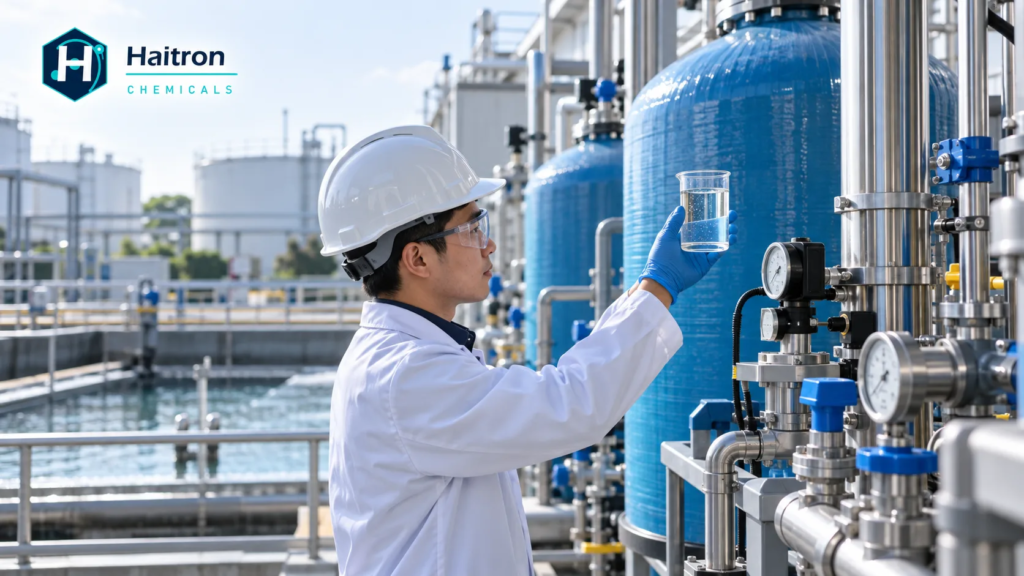
Ammonia removal from wastewater usually happens in one of four ways: bacteria (nitrification and denitrification), air or steam stripping, breakpoint chlorination, or ion exchange. Bacteria handle most city wastewater. Stripping suits very strong streams, chlorination cleans up small leftovers, and ion exchange polishes soft water or recovers ammonium to reuse.
The best choice depends on three things: what your permit limits, how much ammonia you have, and what else is in the water. Let’s walk through each one.
Start With Your Permit Limit
Labs measure nitrogen in three related ways. Any of them can show up in a discharge permit, SCS Engineers explains in a 2018 technical bulletin.
| Measure | What it counts |
| Ammonia nitrogen | Ammonia plus ammonium |
| TKN (Total Kjeldahl Nitrogen) | Ammonia nitrogen plus organic nitrogen |
| Total nitrogen | TKN plus nitrite and nitrate |
This matters because some methods only remove ammonia. A US Army technical review noted that stripping, ion exchange and chlorination take out ammonia but leave nitrate behind. Only nitrification plus denitrification reduces both.
So if your permit limits total nitrogen, simply turning ammonia into nitrate won’t be enough. For rivers and lakes, ammonia limits often follow the EPA’s 2013 water quality criteria, which change with pH and temperature.
Why pH and Temperature Matter
In water, ammonia shows up in two forms. Ammonium (NH₄⁺) is dissolved in the water, like sugar in tea. Ammonia (NH₃) is a gas that can escape, like fizz from soda.
pH decides which form wins:
- Below about pH 7, almost all of it is ammonium.
- Above about pH 10, almost all of it is ammonia gas.
- Temperature shifts it too. At pH 9, water at 40°F holds about 10% ammonia gas, but at 90°F it holds about 48%, according to SCS Engineers.
That’s why stripping needs high pH and warm water. It’s also why ion exchange works on ammonium at normal pH. Ammonia gas is the form most harmful to fish, so permit limits often depend on pH and temperature.
Ammonia Removal From Wastewater: Methods Compared
Here’s a side by side look at the main options. The ranges come from SCS Engineers unless noted.
| Method | Best for | Removes total nitrogen? | Main downsides |
| Nitrification only (activated sludge) | Under about 30 to 40 mg/L | No, it makes nitrate | Needs oxygen, alkalinity and steady temperature |
| Nitrification plus denitrification (including MBR and SBR) | Low to very high (MBR: 100 to over 2,000 mg/L) | Yes | Bigger footprint and careful control |
| Air stripping | About 10 to 100 mg/L | No | High pH, scaling, odor, freezing |
| Steam stripping | Over about 100 mg/L | No | Energy for steam |
| Breakpoint chlorination | Under about 20 mg/L | No | Lots of chlorine, adds salts, toxic gas risk |
| Ion exchange | Low levels, final polishing | No | Hardness competes; regenerant to handle |
| Struvite precipitation | Strong streams with phosphorus | Partly | Needs magnesium and phosphate in balance |
Biological Nitrification and Denitrification
Bacteria do the work in two steps. In tanks with air, one group of bacteria turns ammonia into nitrite, then nitrate. In tanks without oxygen, another group turns nitrate into nitrogen gas, which floats away harmlessly.
This is the standard method for city wastewater, mostly because it fits right into normal activated sludge plants. Newer methods like anammox use special bacteria that turn ammonium and nitrite straight into nitrogen gas. A 2024 review by Farghali and colleagues found nitrification and anammox in membrane bioreactors stand out for low cost and less sludge.
Air and Steam Stripping
First, you raise the pH to about 10.8 to 11.5, so ammonium turns into ammonia gas. Then you blow air or steam through the water to carry the gas out. Warming the water to about 25 to 50°C helps, Almawatech notes.
This works well on strong wastewater like landfill leachate. But watch for scaling, odor and freezing in cold weather. You also need to catch the ammonia gas, usually in an acid scrubber, or it just becomes air pollution.
Breakpoint Chlorination
Adding enough chlorine turns ammonia into nitrogen gas. SCS Engineers says it takes about 7.6 pounds of chlorine per pound of ammonia, often more if other materials are in the water. It also uses up about 15 mg/L of alkalinity for every mg/L of ammonia.
That’s why chlorination works best as a final polish for levels under about 20 mg/L. Good mixing and pH control help avoid a dangerous gas called nitrogen trichloride.
Ion Exchange: Zeolite or Resin?
Ion exchanges ammonium for a harmless ion, like trading one marble for another. But the type of media matters a lot.
- Natural zeolite (clinoptilolite) prefers ammonium over calcium and magnesium, a 1999 study by Cooney and colleagues found. That makes it the usual pick for wastewater. Even so, hardness can still use up more than half its capacity in some water.
- Synthetic cation resin removes ammonium too. But a 2025 study by Gomelya and colleagues found standard strong acid cation resin and weak acid cation resin both prefer calcium and magnesium over ammonium. In hard water, the resin fills up with hardness first.
As a resin maker, here’s our honest take. Synthetic resin works best when the water is already low in hardness, for example after softening or membrane treatment. It’s also useful when you want to recover ammonium. The same 2025 study found acid recharging worked best, and suggested acids that let the used solution become fertilizer.
Either way, SCS Engineers says ion exchange needs pretreatment to remove solids and competing minerals like hardness, aluminum and iron.
Recovering Ammonia Instead of Destroying It
Some plants turn ammonia into something useful. Struvite precipitation combines ammonium with magnesium and phosphate to make a solid fertilizer. The 2024 review calls it an efficient and recyclable method.
Stripping with an acid scrubber, or acid recharged ion exchange, can also produce ammonium salts for reuse.
How to Choose: A Simple Decision Path
Follow these steps to narrow down your options for ammonia removal from wastewater:
- Check your limit. If it’s total nitrogen, you need denitrification or a method that truly removes nitrogen.
- Check your concentration. Very high levels point to stripping, membrane bioreactors or anammox. Moderate levels point to biological treatment or air stripping. Low levels under about 20 mg/L suit chlorination or ion exchange.
- Check your water chemistry. High hardness rules out synthetic resin as a first step, so try zeolite, or soften first. Our guide on how to remove calcium from water compares softening options.
- Check off site options. If a nearby city treatment plant will take your wastewater, SCS Engineers says that’s often the cheapest choice, though they may charge by ammonia load.
- Run a pilot test. Small tests catch problems that chemistry alone can’t predict.
Common Mistakes to Avoid
- Counting nitrate as “removed” when your permit limits total nitrogen.
- Stripping ammonia without capturing the gas.
- Not adding enough alkalinity, so pH crashes during chlorination or nitrification.
- Using resin on hard, dirty water and getting very short runs.
- Skipping a pilot test when your wastewater changes with the seasons.
Conclusion
Good ammonia removal from wastewater starts with your permit, your concentration and your water chemistry. Gather a recent test that covers ammonia nitrogen, TKN, total nitrogen, hardness, pH, temperature and solids. Then use the decision path above to find the method that fits.
FAQs
What’s the difference between ammonia and ammonium?
Ammonium is dissolved in water, while ammonia is a gas. pH and temperature decide the balance, and labs usually report both together.
Does raising pH remove ammonia?
Not by itself. It turns ammonium into ammonia gas, which stripping can then remove. Without stripping, the ammonia stays in the water and becomes more harmful.
How much ammonia can activated sludge handle?
SCS Engineers suggest regular activated sludge for wastewater under about 30 to 40 mg/L ammonia. Higher levels usually need other designs.
Can Haitron help with ammonia removal from wastewater?
Yes. Haitron makes cation exchange resins used for polishing low hardness water and recovering ammonium. Share your water analysis with our team, and we’ll tell you honestly whether resin, zeolite or another method fits your ammonia removal from wastewater best.